Showing posts with label liturgy. Show all posts
Showing posts with label liturgy. Show all posts
Saturday, February 26, 2011
"Worship & Sacraments: Q & A" with Brent Peterson
The last part of the previous video - this is where it gets fun!
Feel free to discuss in the comments.


Friday, February 25, 2011
Rev. Brent Peterson PhD on "Worship & The Sacraments"
Here's part one of the video I shot of Brent's M11 session (which actually picks up about half way through the formal part of his presentation - I was about 20 min. late due to a lunch meeting).
Any comments on this, other than unbridled support and agreement?! Let's discuss. There's already been some lively discussion over at NazNet.
As soon as it's finished uploading, I will post the Q & A, which is where he made some of his most provocative points (perhaps not too provocative to those who frequent this blog, but to some they would be).
Tuesday, February 15, 2011
Ready to Surrender
 As a Christian and as a pastor, worship is important to me. How we worship, why we worship, when we worship, the ways we worship, and what/who we worship are all important to me. Yet, so often these things are not important to the others I am talking to. Often times when talking about worship with pastors and leaders the conversation is reduced to "How many were there?" and "How moved were they?"
When I talk about the need for a renewed worship, people respond with discussions of transitioning from "traditional music" (hymnal) to "contemporary music" (everything published after the hymnal). Or I hear statements like I did a couple of weeks ago with a group of pastors, when one pastor stated publicly, "I actually quit going to worship for a period of time before becoming a pastor. I mean, I understood why we worshiped but I just didn't have anything in common with the church people. But now that we have a "cowboy church" I just feel such a great sense of unity."
Thursday, February 03, 2011
Being Anglican in the Evangelical Church
 I was asked by my DS what it was like being an evangelical at an Anglican seminary. My response: "A lot easier than being an Anglican serving an Evangelical Church."
We both chuckled.
More seriously though. We talk about liturgy around here quite a lot. The love of liturgy and sacraments is what gives us unity. But we often talk (at least I do) in the realm of idealism. What about the world of reality? I have been working to introduce some liturgy to my congregation. We have moved to weekly Eucharist. I wear an alb and stole. We do corporate written prayers and read the Psalms responsively. But it is starting to feel like I bit off more than my people can chew.
So my question is this: what might liturgical / sacramental worship realistically look like is a small, evangelical, holiness church? My only stipulations are these:
1) Four-fold shape
2) The Eucharistic liturgy remain largely in tact
3) The liturgy ought to be the same each week
What would such a service need to look like to capture the essence of liturgy and to be accepted by a "typical" Nazarene congregation?
Thursday, January 20, 2011
Worshiping God, or Ourselves? Or, Why We Need a Liturgy
I am in charge of the worship in a church whose worship "style" is decisively "contemporary." Congregational singing is accompanied by a guitar-driven "praise band" (drums, bass, guitars, piano/keyboard) and augmented by a choir and praise team (3-4 vocalists on individual mics). At the front of the sanctuary we have two large screens on which we digitally project lyrics, scripture readings, videos (for announcements and illustrations), images and graphics intended to reinforce the sermon theme or other elements of the service. The majority of the songs we sing have been published within the past decade.

Yet, our services incorporate aspects of fairly traditional/historical or even liturgical worship, although the congregation would not recognize them as such. While they may not flow in precisely the same order each week, we have identified some "essential elements" of worship which appear in every service: call to worship, welcome (including a few key announcements) and invocation, passing the peace, congregational singing (the so-called "worship set"), a time of prayer ("open altar") and communion led by the pastor, an offering, the sermon (including scripture reading), some type of response, the benediction and dismissal.
Yet, our services incorporate aspects of fairly traditional/historical or even liturgical worship, although the congregation would not recognize them as such. While they may not flow in precisely the same order each week, we have identified some "essential elements" of worship which appear in every service: call to worship, welcome (including a few key announcements) and invocation, passing the peace, congregational singing (the so-called "worship set"), a time of prayer ("open altar") and communion led by the pastor, an offering, the sermon (including scripture reading), some type of response, the benediction and dismissal.
Tuesday, December 07, 2010
Fingernails On A Chalkboard

Before reading this entry please take a few seconds to watch this video clip, make sure to turn the sound up.
These next five words, this next phrase elicits the same "fingernail on a chalkboard" response from me every time I hear it. Are you ready? Here it is.
Helpful Inspiration of Social Worship--insert chalkboard sound at high volume
These five words come from the Manual of the Church of the Nazarene and can be found in our Membership Covenant. These five words make up the bulk of our theology of worship. When bringing people into the church, when inviting them to speak covenanting words of membership, the best we can come up with, as to the the purpose and priority of worship is, for its Helpful Inspiration.
Friday, December 03, 2010
Joseph's Baptism
Sunday was a major milestone not only in Joseph's life, and the life of our family, but in the life of Xenia Naz as well. It may have been the first infant baptism ever at my church, and certainly the first one done like this.
I ended up tweaking a few things in the final version of the liturgy under the advisement of our assistant District Superintendent, who is presently serving as our interim pastor. He was remarkably supportive of all this, and did a fantastic job "setting up" the baptism. (You can listen to his comments/explanation during the first 5-6 min of his sermon from Sunday - although I encourage you to listen to the whole thing - it is masterful....and he invokes Rob Staples, so bonus points for that!)
All in all, it was wonderful. Immediately after the service, I found myself in several conversations, most of which were of the "so-we-actually-do-that?" variety...and not in an offended or concerned (heh) sense, but more arising from intrigue/fascination/curiosity. The most thorough discussion I had was with a woman with a Catholic background who sings in my choir. Her elementary-age daughter was baptized in the Catholic church, and I think she just genuinely wanted to know whether that baptism was valid...legit...sufficient. I told her: absolutely.
Also, let the record show that my dad did a exceptional job officiating, especially in a "scripted" context that is a bit outside his comfort zone. Events like this remind me and Gloria what a means of grace our family is. And although I teased my dad a bit about dousing Joseph six times (correct me if I'm wrong: I think this was a "sextuple affusion"...?) instead of the traditional three, I have to agree with my friend Jeremy's comment: "Make that grace as visible as possible." Amen.
How would a ritual like this fly at your church? What about the church you grew up in?
(If you'd like a .doc version of the liturgy so you can use/amend it, email me.)
Monday, November 29, 2010
Advent Wreath
 Advent has begun. I trust you all have had a great first Sunday of this season.
My wife and I moved to our town in June. She got a job at the Nazarene Church here as part-time pastor alongside the full-time pastor. I was taken on as a one-day-a-week/unpaid deacon. In one of our recent meetings we decided that I would be in charge of the Advent wreath for this year. I thought about using whatever the church had on hand, but I figured, 'You know what, why not just make one.'
So I did (pictured above). I cut pine branches and holly branches and cedar-looking branches and put them together around a circle-shaped 'oasis'. The symbolism of the different foliage is significant, so we took the first part of the service to have a liturgy explaining and sanctifying the making of the Advent wreath. We were happy to find that after the service, many of the congregation complimented the 'new' Advent wreath and appreciated the explanation.
In light of this, I wonder how many of our congregations know what the Advent wreath means? Do any of you take time to explain the meaning of all the elements and not just the candles? I had only participated in a service like this a couple of times and found it to be a really positive experience for our largely 'liturgically deprived' congregation.
Peace,
Joseph
Friday, November 26, 2010
A Service of Infant Baptism
This Sunday (Advent 1a) our son Joseph, who just turned one on Wednesday, will receive the sacrament of baptism. Gloria and I are thrilled that the timing worked out so that our family from both sides is able to be present. (Our now-3-yr-old Andrew was baptized at St. Mary's Cathedral in Glasgow, so none of our family were able to share in the service.) My dad, a Nazarene elder and pastor from Nashville, TN, is in town to officiate my cousin's wedding on Saturday, so he'll be able to preside over his grandson's baptism on Sunday as well, which is about as perfect a solution we could ever come up with in this time of pastoral transition at Xenia Naz.

I thought I'd share the liturgy I've put together for the service. I value your feedback and welcome you to use it, adapt it, share it or rewrite it as you find useful.

I thought I'd share the liturgy I've put together for the service. I value your feedback and welcome you to use it, adapt it, share it or rewrite it as you find useful.
Friday, November 19, 2010
Words When Serving Communion
What do you say to the recipient when you serve communion? When you offer the bread? The cup?

Many liturgies include specific instructions for what the minister should say, such as:
Many liturgies include specific instructions for what the minister should say, such as:
Thursday, November 11, 2010
"Disposing" of the Elements
In an effort to keep my promise to add content more regularly and revitalize the conversation 'round these parts, I was looking back through old posts. I knew there were at least a few instances where I had an idea for what I thought would be a good topic to post about, and created a draft but never finished and published it. This was one, but I hadn't even begun writing it - just had a title! (weird, I know.)


I think it's a good thing to bat around, though - certainly something we have had some discussion about at Xenia Naz: what to do with the elements - the cup in particular - after communion?
Tuesday, December 29, 2009
Epiphany
So, I assume we all made it through Advent and Christmas, and are gearing up for the first Sunday of the new year. If your church is anything like mine, you probably had to tolerate some of the incessant tendencies to bypass Advent and "jump the gun" straight on to Christmas. Examples from my congregation include the pressure to sing Christmas songs - especially "Joy to the World" and the two best-known "angel" songs - during Advent, and, despite my strong urging, the placement of the Christ-child in the manger by the decorating committee, such that the Messiah has seemingly come beginning on Advent 1 (and yet we sing "O Come, O Come Emmanuel" each week, without anyone noticing the disparity).
Still, I must say we do pretty well with the Advent readings and candle-lighting, and our Pastor preaches us through Advent well. And we do a bang-up job (in my humble opinion) with Christmas Eve, which for my third year here was effectively lessons and carols without it necessarily being named thus.
With the exception of our choir musical and children's program (held on Advent 3 and 4 respectively), which inevitably skip ahead, primarily due to available material, we did pretty well. And this year, I didn't even hear that much about song selection during Advent - perhaps my Pastor did and merely shielded me from it - which I have in the past: "Why aren't we singing Christmas songs?!?" ("We will.") "When?!?" ("Christmas Eve, and at least the two Sundays following.") [blank stare]
All that to ask, well, two things I suppose: 1) how'd it go for you in your local context?, and 2) how will you observe Epiphany (if at all)?
I ask because I gather that many of our churches are doing much better (and increasingly so) at observing Advent/Christmas, and even Lent/Holy Week/Easter/Pentecost, which is a move toward better observance of the liturgical calendar that we should celebrate.
But I also gather that holy days like Epiphany, Ash Wednesday, All Saints, and Trinity Sunday (etc) will be a much longer time coming. I'm not sure if it's just ignorance (in which case, we have some teaching to do) or actually resistance (in which case we have some teaching AND some persuading to do) that I sense. Chime in with your thoughts. Grace and peace!
Thursday, March 05, 2009
A Pastor's Responsibility to Prepare
Twice yesterday, I came across accounts of pastors administering the sacraments. Each pastor seemed to have a different approach to his responsibility to prepare the one receiving the sacrament to receive the sacrament. Consider these two scenarios.
1) A pastor has a young college student attending his church. That college student is a self-proclaimed atheist. The student has been in attendance at several communion services, but has never received because of his atheism. This particular service, however, the student came to the altar to receive communion. Before serving him, the pastor asked him a question, "Has something about your atheism changed?" The student convincingly answered affirmatively and for the first time received the sacrament as a follower of Christ. Later the pastor and the student got together to discuss this perceived change.
2) A pastor has felt the need to encourage his people to experience the sacrament of baptism. So he prepares a beautiful worship service that will conclude with a baptism service. He includes videos of people talking about baptism and preaches a sermon discussing the sacrament. At the close of the sermon, instead of the traditional "altar call," there is a baptism call. Many people stood up, came forward, and right there and then got baptized.
These two pastors seem to take very different approaches to "preparing" their people to rightfully receive the sacraments. So my question is this: (1) What is a pastor's responsibility to the church and to the people to prepare candidates for receiving the sacraments' (2) What do you do to prepare your parishioners or how does your pastor prepare you/your congregation to receive the sacraments?
Wednesday, November 19, 2008
Advent Practices
With the season of Advent almost here, I was wondering what are some of your Advent practices? Do you use an Advent wreath, when do you start singing Christmas carols, when do you decorate the Church and what are some of your favorite Advent hymns? One thing I have done is to use the collect for the First Sunday of Advent from the BCP as a opening prayer each of the four Sundays of Advent.
"Almighty God, give us grace that we may cast away the works of darkness, and put upon us the armor of light, now in the time of this mortal life in which thy Son Jesus Christ came to visit us in great humility; that in the last day, when he shall come again in his glorious majesty to judge both the quick and the dead, we may rise to the life immortal; through him who liveth and reigneth with thee and the Holy Ghost, one God, now and for ever. Amen"
Peace,
Pastor Steven
Wednesday, May 28, 2008
"Liturgy and the Arts" by Albert Rouet
I've just started reading this exceptional little book, which was recommended to me by theologian Philip Sheldrake (author of Spaces for the Sacred) at a conference about 2 years ago. It's one of those that might have slipped under the radar for many folks who might otherwise be very interested in it's content. I'd better not attempt anything like a review since I'm still reading it - although I really appreciate what I've read so far - but I thought I'd share a few highlights to whet some appetites...and perhaps provoke some dialogue.
This first quote is from translator Paul Philibert's introduction, and is (I assume) more summative of the work as a whole; the remaining quotes are Rouet himself:
"So another principle of Rouet's theology is that the arts are not for ornamentation, but for evocation. Their role is not to fabricate an alternative world alongside ordinary life, with all its burdens and ugliness, even though the beautiful can be a relief from the heaviness of daily tedium. Rather, the arts have as their role the disclosure of holiness within the ordinary...The function of the arts in the Christian life and in liturgy is to map out the location of God's presence and to detonate the sacramental potential of the world." (p. ix - emphasis added)
"Liturgy is the transformation of a people. It addresses itself to people within their culture and their circumstances. It is something for today." (p. 10)
"Movement toward conversion is the real object of liturgy. This is how it makes a people to become "a people," creates them as the people of God. The real question is not if this liturgy pleases you, nor even if you find it beautiful. The real question is whether the liturgical rites move people forward to walk with God and to move toward God." (p. 19)
This next quote reminds me of something Dr. Tim Green said in his recent Hicks' Holiness Series, delivered at Mount Vernon Nazarene University (very worthwhile - available as a podcast here). To sum up the first of the three sermons/lectures, Tim said that the beginning of holiness - which is the story of what God is and has always been doing in the lives of God's people - is to receive life as sheer gift.
"Worshipping people are beggars. Because they know their poverty, their liturgy becomes the praise of that One who gives them everything. Liturgy succeeds when those who celebrate realize that they have been pushed beyond themselves..." (p. 20)
No promises, but perhaps a full-fledged review will follow. (Although considering I have two different journals waiting on reviews from me - Clive Marsh's Theology Goes to the Movies and John Caputo's What Would Jesus Deconstruct? - don't hold your breath!)
Saturday, March 03, 2007
Prayers of the Eucharist, or "so many liturgies, so few Sundays..."
In the previous post's comment thread, Brian (UrbanMonk) began to take us a bit deeper into discussion about the possible structures of our eucharistic celebrations and the range of possible prayers that we might utilize. Although I'm not sure how "eloquently" (his word) I can comment, he did allude to my interests in liturgical history and eucharistic theology, which I took as an invitation to expand a bit on the subject.
Now, while I naturally have convictions and preferences about liturgy, I hesitate to make any strong recommendations of particular "best" liturgies, because I know different folks have different views and theological opinions about the eucharist. But I will indicate a few things for those who might be interested in trying out or adapting certain historic rites and prayers.
My doctoral supervisor's late father, Ronald Jasper, was a prominent liturgist in the Church of England, and headed up the ecumenical Joint Liturgical Group in the 60s and 70s. He co-edited an anthology with Geoffrey Cuming, now in its 3rd edition, called Prayers of the Eucharist: Early and Reformed (Liturgical Press, 1990), which despite its boring cover design is an excellent resource, covering everything from Jewish table blessings through the 1790 Prayer book of the Protesant Episcopal Church. However, note that it contains only the anaphora or eucharistic prayer of a given liturgy, NOT the whole liturgy. Liturgies of the Western Church, ed. Bard Thompson (Fortress Press, 1961/1980) is a good resource for complete liturgies beginning with Justin Martyr and ending with Wesley's Sunday Service - but it's only the major liturgies, e.g. the Roman Rite, Luther, Calvin, Zwingli, Bucer, Knox, etc, and they're all Western, which to me is a bummer. Have a look at Richard Baxter's 1661 liturgy ("The Savoy Liturgy"), which is in both of the aforementioned books, and in the Jasper and Cuming book, the Nonjurors' Liturgy of 1718, both of which I think are of particular interest for those with Wesleyan proclivities.
Baxter's epiclesis: "This bread and wine, being set apart, and consecrated to this holy use by God's appointment, are now no common bread and wine, but sacramentally the body and blood of Christ." This statement has a charming simplicity about it, especially when considered in context of the whole liturgy, which over and over emphasizes sanctification, both of us and of the meal, which is "meat and drink indeed." And I love this exhortation at the start of the liturgy of the sacrament:
The Nonjurors' liturgy, which certainly influenced the Wesleys via William Law, actually refers to the eucharist as a "Sacrifice", which is somewhat shocking for the 18th century Protestant context. This epiclesis says:
To go back even earlier, WAY back in fact, the Jasper and Cuming book also includes the Egyptian Anaphora of St. Basil (probably 4th century), which doesn't include a request for the Holy Spirit to change the bread and the wine but only that the "Holy Spirit may descend upon us and upon these gifts that have been set before you, and may sanctify them and make them holy of holies. Make us all worthy to partake of your holy things for [the] sanctification of soul and body, that we may become one body and one spirit..." Anything with sanctification language should work pretty well in our context(s), I would think, so this is an excellent and very ancient possibility.
If I may take the liberty to say also that I am very inspired by and proud of the ministry team at Community Church of the Nazarene, Longsight (near Manchester, England and Nazarene Theological College), who in addition to having a weekly Word and Table service was brave enough to use an adaptation of the entire Coptic liturgy of St. Basil for their service on Pentecost Sunday last year - my wife was at the service and brought me back a copy of their liturgy booklet. The version they used asks that the "Holy Spirit descend upon these gifts set forth, and purify them, change them and manifest them as a sanctification of your saints." The entire liturgy is wonderful. And as a sort of side-note, Longsight celebrates their liturgy in a very small, communal setting - usually only 10-20 people seated in an oval with a small table bearing the bread and cup at one end. They use a combination of lay and ordained leaders so that, e.g., the "priest" parts of the liturgy, the sermon, and the epiclesis, might not always be performed by a member of the clergy.
Along these lines, I have also heard about experiments with the entire congregation praying the epiclesis, which is a decided break with tradition but might have its merits in a Nazarene setting. So, for example, everyone would pray together:
And a final word, if I may: never forget that eucharistic prayers, and the liturgies they are a part of, can as (if not more) often be instruments of polemic and ideology as they can be true expressions of worship to the Almighty - see John Knox's "Forme of Prayers" 1556 as one example: "...let us not suffer our minds to wander about the consideration of these earthly and corruptible things, which we see present to our eyes and feel with our hands [i.e. the bread and wine], to seek Christ bodily present in them, as if he were enclosed in the bread and wine, or as if these elements were turned and changed into the substance of his flesh and blood...[but] lift up our minds by faith above all things worldly and sensible..." (&c.) (Seems to me that somebody doesn't quite understand that sacraments are necessarily "worldly and sensible," embodied and bodily, and only as such do they re-present the incarnate Christ.)
I guess what I mean is, even though many of us feel strongly about the need to emphasize Christ's real presence in the eucharist, I think we need to exercise caution and a bit of restraint to ensure we're not cramming it down people's throats (!) and turning worship and celebration and communion into soap-boxing. Although I've not been given many opportunities to try it out in practice in Nazarene churches, I suspect the way to go is to just use these (or any) prayers as naturally and nonchalantly as possible and hope that the theological significance seeps in gradually to the hearts and minds of all those who participate, such that we all are sanctified and transformed.
Now, while I naturally have convictions and preferences about liturgy, I hesitate to make any strong recommendations of particular "best" liturgies, because I know different folks have different views and theological opinions about the eucharist. But I will indicate a few things for those who might be interested in trying out or adapting certain historic rites and prayers.
My doctoral supervisor's late father, Ronald Jasper, was a prominent liturgist in the Church of England, and headed up the ecumenical Joint Liturgical Group in the 60s and 70s. He co-edited an anthology with Geoffrey Cuming, now in its 3rd edition, called Prayers of the Eucharist: Early and Reformed (Liturgical Press, 1990), which despite its boring cover design is an excellent resource, covering everything from Jewish table blessings through the 1790 Prayer book of the Protesant Episcopal Church. However, note that it contains only the anaphora or eucharistic prayer of a given liturgy, NOT the whole liturgy. Liturgies of the Western Church, ed. Bard Thompson (Fortress Press, 1961/1980) is a good resource for complete liturgies beginning with Justin Martyr and ending with Wesley's Sunday Service - but it's only the major liturgies, e.g. the Roman Rite, Luther, Calvin, Zwingli, Bucer, Knox, etc, and they're all Western, which to me is a bummer. Have a look at Richard Baxter's 1661 liturgy ("The Savoy Liturgy"), which is in both of the aforementioned books, and in the Jasper and Cuming book, the Nonjurors' Liturgy of 1718, both of which I think are of particular interest for those with Wesleyan proclivities.
Baxter's epiclesis: "This bread and wine, being set apart, and consecrated to this holy use by God's appointment, are now no common bread and wine, but sacramentally the body and blood of Christ." This statement has a charming simplicity about it, especially when considered in context of the whole liturgy, which over and over emphasizes sanctification, both of us and of the meal, which is "meat and drink indeed." And I love this exhortation at the start of the liturgy of the sacrament:
"The benefit of the Sacrament is not to be judged of only by present experience and feeling, but by faith. God having appointed us to use it, and promised his blessing, we may and must believe that he will make good his promise; and whatever we feel at present, that we sincerely wait not only him in vain."Point of interest: my colleagues at Nazarene Theological College tell me that Baxter is an influence on Wesley, but I can't say much about this connection - maybe a possible topic for further research, or for someone who knows what they're talking about to comment on!
The Nonjurors' liturgy, which certainly influenced the Wesleys via William Law, actually refers to the eucharist as a "Sacrifice", which is somewhat shocking for the 18th century Protestant context. This epiclesis says:
"...send down thine Holy Spirit, the witness of the Passion of our Lord Jesus, upon this Sacrifice, that he may make this Bread the Body of thy Christ, and this Cup the Blood of thy Christ; that they who are partakers thereof, may be confirmed in godliness, may obtain remission of their sins, may be delivered from the Devil and his snares, may be replenished by the Holy Ghost, may be made worthy of thy Christ, and may obtain everlasting life, Thou, O Lord Almighty..."That's the stuff right there. Change all the "they"s and "their"s to "we" and "our" and you've got yourself a pretty incredible prayer of consecration. Who wouldn't be moved by that? (Give that one a couple of tries and we might find that the eucharist can be a "converting ordinance" after all!)
To go back even earlier, WAY back in fact, the Jasper and Cuming book also includes the Egyptian Anaphora of St. Basil (probably 4th century), which doesn't include a request for the Holy Spirit to change the bread and the wine but only that the "Holy Spirit may descend upon us and upon these gifts that have been set before you, and may sanctify them and make them holy of holies. Make us all worthy to partake of your holy things for [the] sanctification of soul and body, that we may become one body and one spirit..." Anything with sanctification language should work pretty well in our context(s), I would think, so this is an excellent and very ancient possibility.
If I may take the liberty to say also that I am very inspired by and proud of the ministry team at Community Church of the Nazarene, Longsight (near Manchester, England and Nazarene Theological College), who in addition to having a weekly Word and Table service was brave enough to use an adaptation of the entire Coptic liturgy of St. Basil for their service on Pentecost Sunday last year - my wife was at the service and brought me back a copy of their liturgy booklet. The version they used asks that the "Holy Spirit descend upon these gifts set forth, and purify them, change them and manifest them as a sanctification of your saints." The entire liturgy is wonderful. And as a sort of side-note, Longsight celebrates their liturgy in a very small, communal setting - usually only 10-20 people seated in an oval with a small table bearing the bread and cup at one end. They use a combination of lay and ordained leaders so that, e.g., the "priest" parts of the liturgy, the sermon, and the epiclesis, might not always be performed by a member of the clergy.
Along these lines, I have also heard about experiments with the entire congregation praying the epiclesis, which is a decided break with tradition but might have its merits in a Nazarene setting. So, for example, everyone would pray together:
"Hear us, most merciful Father, and send your Holy Spirit upon us, and upon these gifts of bread and wine, that overshadowed by His life-giving power, they may be for us the body and blood of your Son, Jesus Christ, that we may be kindled with the fire of your love, and renewed for the service of your Kingdom."Those are the words of epiclesis in the liturgy of the Scottish Episcopal Church, which is my own current worship setting (although only for a short time longer...it's been incredible, but the PhD is drawing to a close and it's nearly time to move back to the USA and Nazarenedom). The SEC liturgy revisions of 1982 were heavily influenced by Eastern liturgies, so there is a definite affinity here. The whole thing is available online directly from the SEC, and earlier versions of the Scottish liturgy can be found on the queen mother of prayer-book sites, although it must be said that the earlier versions are extremely "groveling" and penitential (e.g. "We acknowledge and bewail our manifold sins and wickedness, which we form time to time most grievously have committed by thought, word and deed, against thy Divine Majesty, provoking most justly thy wrath and indignation against us...we are not worthy so much as to gather up the crumbs from under Thy table..." &c ~1929 Scottish BCP - very Cranmerian), such as might be objectionable to Nazarenes who (as my father-in-law says) "don't believe in a sinnin' religion." The 1982 revision was a pretty significant move in a new direction, and I have grown quite fond if it, I must confess.
And a final word, if I may: never forget that eucharistic prayers, and the liturgies they are a part of, can as (if not more) often be instruments of polemic and ideology as they can be true expressions of worship to the Almighty - see John Knox's "Forme of Prayers" 1556 as one example: "...let us not suffer our minds to wander about the consideration of these earthly and corruptible things, which we see present to our eyes and feel with our hands [i.e. the bread and wine], to seek Christ bodily present in them, as if he were enclosed in the bread and wine, or as if these elements were turned and changed into the substance of his flesh and blood...[but] lift up our minds by faith above all things worldly and sensible..." (&c.) (Seems to me that somebody doesn't quite understand that sacraments are necessarily "worldly and sensible," embodied and bodily, and only as such do they re-present the incarnate Christ.)
I guess what I mean is, even though many of us feel strongly about the need to emphasize Christ's real presence in the eucharist, I think we need to exercise caution and a bit of restraint to ensure we're not cramming it down people's throats (!) and turning worship and celebration and communion into soap-boxing. Although I've not been given many opportunities to try it out in practice in Nazarene churches, I suspect the way to go is to just use these (or any) prayers as naturally and nonchalantly as possible and hope that the theological significance seeps in gradually to the hearts and minds of all those who participate, such that we all are sanctified and transformed.
Monday, December 11, 2006
my favorite band + my favorite act of worship = ...?
Ever heard of a "U2charist"? I hadn't either.
(I really don't know how to feel about this.)
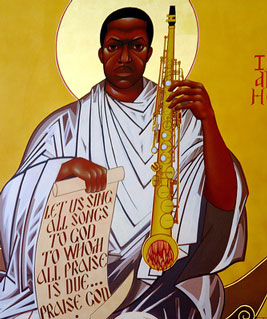
I might actually be more sympathetic, at least in theory, to the impulse (hee hee, pun intended) behind Saint John Coltrane Church.
But maybe I just dig the icons.
(I really don't know how to feel about this.)
I might actually be more sympathetic, at least in theory, to the impulse (hee hee, pun intended) behind Saint John Coltrane Church.
But maybe I just dig the icons.
Friday, September 01, 2006
Worship: A Big Fat Waste Of Time
...at least that's what Marva Dawn thinks. Of course, she doesn't mean it in the way you might think she means it. Her book, A Royal "Waste" of Time: The Splendor of Worshipping God and Being Church for the World, bears this ironic title, not because she in fact considers worship a waste of time, but because it appears to be so to the world. That is, "By engaging in [worship], we don't accomplish anything useful in our society's terms" (p. 1). But she goes on to say that this is right and good: worship shouldn't be about utilitarian aims, it should be an appropriately gratuitous response to the lavish love of God.
I think she misses at least one aspect of this idea of worship as a "time-waster," that is, the idea that "liturgical time" is outside of mundane (earthly) time because it is oriented to the clock of God's Kingdom. Liturgical time brings the past into the present, as we recall the Last Supper, Christ's death and resurrection; and it brings the end of time (eschaton) near to us, giving us a glimpse of the worship of God that takes place perpetually in heaven around God's throne, as well as a foretaste of the heavenly banquet that awaits us. (Actually, she might pick this up somewhere - I confess I haven't read the entire book.) In this sense, too, worship is a waste of time - by the world's economy of time, we could be doing better, more productive things; also, by the Kingdom's economy of time, it is a con-fusion (literally "to run together") of times. Or, more specifically, it is the subversion of kronos, linear or sequential time, by kairos, which is "God's appointed time," the time of an event, of the happening of something special, something crucial. "Kiaretic" time is, even by etymologic similarity, the time of the Cross (crucis), where earthly time stands still in the wonder of this meeting, this intersection of heaven and earth.
Still, perhaps there is something to thinking of worship as a waste of time in the most literal and mundane sense. Adam Kotsko, a former Nazarene, has expressed this much better than I ever could:
Even then, I have to believe that it matters, that what I've done by submitting myself to these strange practices of Christian worship, even when it can only be described as "going through the motions" (so often the evangelical criticism of liturgy), is somehow significant, even if it doesn't seem to "make a difference." To worship in the absence of God demands a lot more of faith than to do so in God's overwhelming (if occasionally manufactured) presence...does it not?
I think she misses at least one aspect of this idea of worship as a "time-waster," that is, the idea that "liturgical time" is outside of mundane (earthly) time because it is oriented to the clock of God's Kingdom. Liturgical time brings the past into the present, as we recall the Last Supper, Christ's death and resurrection; and it brings the end of time (eschaton) near to us, giving us a glimpse of the worship of God that takes place perpetually in heaven around God's throne, as well as a foretaste of the heavenly banquet that awaits us. (Actually, she might pick this up somewhere - I confess I haven't read the entire book.) In this sense, too, worship is a waste of time - by the world's economy of time, we could be doing better, more productive things; also, by the Kingdom's economy of time, it is a con-fusion (literally "to run together") of times. Or, more specifically, it is the subversion of kronos, linear or sequential time, by kairos, which is "God's appointed time," the time of an event, of the happening of something special, something crucial. "Kiaretic" time is, even by etymologic similarity, the time of the Cross (crucis), where earthly time stands still in the wonder of this meeting, this intersection of heaven and earth.
Still, perhaps there is something to thinking of worship as a waste of time in the most literal and mundane sense. Adam Kotsko, a former Nazarene, has expressed this much better than I ever could:
"I don't want a worship experience at all. Or maybe I do. I want to stand-sit-kneel every so often, I want to say the words the congregation is supposed to say, I want to sit patiently through the bad homily, I want to taste the wafer and maybe the watered-down wine -- I want to make sure I don't forget. It's nice to be reminded, every so often, that this stupid and pointless thing is happening, and to participate in it, to waste a half hour on it and walk away with nothing. I think that's important."(Excerpted from his post, which you should read if you have a moment.) As much as a I talk about, think about, write about, read about, and participate in liturgy, I confess there are many times when what I feel is precisely nothing. And as a good Nazarene boy, I can't help but think, "Well, why did I even bother?" If I leave feeling even more alienated from God and perhaps even from other people; if I leave with more of a profound sense of God's absence than of God's presence, well, then isn't something wrong? With me? With the liturgy? Maybe the music wasn't good enough. Maybe the sermon was weak. Maybe my "heart wasn't in the right place."
Even then, I have to believe that it matters, that what I've done by submitting myself to these strange practices of Christian worship, even when it can only be described as "going through the motions" (so often the evangelical criticism of liturgy), is somehow significant, even if it doesn't seem to "make a difference." To worship in the absence of God demands a lot more of faith than to do so in God's overwhelming (if occasionally manufactured) presence...does it not?
Monday, August 28, 2006
Report from the Front Lines
I guess I am attempting this first blog mostly to earn the right to have my name in the prestigious list to the right (contributors). I've enjoyed reading the stuff I've found here, and I truly appreciate Brannon's efforts to make this a place where ideas can be exchanged about an area which is a passion of mine. I am a pastor in a Nazarene Church in the South. This is my 3rd church and I truly love the Church of the Nazarene. I have pastored in three different regions, with three very distinct groups of people inhabiting each Church. The Church I am in right now is largely white-collar, and we have an ever-increasing contingent of students and grad students from Baylor University attending. I have truly loved sharing with this Church my passion for worship, the Sacraments and the Christian calendar. I’ll share two interesting accounts very briefly, then try to sum up my rambling and get out as painlessly as possible.
Wednesday, August 23, 2006
Infant Baptism: The Plot Thickens
With a little self-motivation and hard work, Joseph has made some interesting discoveries about the history of infant baptism in the COTN and shares with us a summary of his preliminary research.
Subscribe to:
Posts (Atom)