Showing posts with label worship. Show all posts

Tuesday, February 15, 2011

Ready to Surrender

As a Christian and as a pastor, worship is important to me. How we worship, why we worship, when we worship, the ways we worship, and what/who we worship are all important to me. Yet, so often these things are not important to the others I am talking to. Often times when talking about worship with pastors and leaders the conversation is reduced to "How many were there?" and "How moved were they?"

When I talk about the need for a renewed worship, people respond with discussions of transitioning from "traditional music" (hymnal) to "contemporary music" (everything published after the hymnal). Or I hear statements like I did a couple of weeks ago with a group of pastors, when one pastor stated publicly, "I actually quit going to worship for a period of time before becoming a pastor. I mean, I understood why we worshiped but I just didn't have anything in common with the church people. But now that we have a "cowboy church" I just feel such a great sense of unity."

Thursday, February 03, 2011

Being Anglican in the Evangelical Church

I was asked by my DS what it was like being an evangelical at an Anglican seminary. My response: "A lot easier than being an Anglican serving an Evangelical Church."
We both chuckled.

More seriously though. We talk about liturgy around here quite a lot. The love of liturgy and sacraments is what gives us unity. But we often talk (at least I do) in the realm of idealism. What about the world of reality? I have been working to introduce some liturgy to my congregation. We have moved to weekly Eucharist. I wear an alb and stole. We do corporate written prayers and read the Psalms responsively. But it is starting to feel like I bit off more than my people can chew.

So my question is this: what might liturgical / sacramental worship realistically look like is a small, evangelical, holiness church? My only stipulations are these:

1) Four-fold shape
2) The Eucharistic liturgy remain largely in tact
3) The liturgy ought to be the same each week

What would such a service need to look like to capture the essence of liturgy and to be accepted by a "typical" Nazarene congregation?

Tuesday, February 01, 2011

Hauerwas on Worship and Evangelism


I came across an excellent article by Stanley Hauerwas on the interesting position that has emerged within 'evangelical' churches that assumes there is a difference in worship and evangelism. Basing his assumption in the methods and practices currently used by a large portion of the Church, Hauerwas commented,

'Currently some Methodists are even suggesting, in the interest of church growth (which has become synonymous in some circles with evangelism), that worship must be made more "user-friendly". They thus assume a tension exists between worship and evangelism.'

Upon reflection, Hauerwas concluded that the 'tension' that seems to exist between worship and evangelism is actually a misrepresentation of true worship.

Thursday, January 20, 2011

Worshiping God, or Ourselves? Or, Why We Need a Liturgy

I am in charge of the worship in a church whose worship "style" is decisively "contemporary."  Congregational singing is accompanied by a guitar-driven "praise band" (drums, bass, guitars, piano/keyboard) and augmented by a choir and praise team (3-4 vocalists on individual mics).  At the front of the sanctuary we have two large screens on which we digitally project lyrics, scripture readings, videos (for announcements and illustrations), images and graphics intended to reinforce the sermon theme or other elements of the service. The majority of the songs we sing have been published within the past decade.


Yet, our services incorporate aspects of fairly traditional/historical or even liturgical worship, although the congregation would not recognize them as such.  While they may not flow in precisely the same order each week, we have identified some "essential elements" of worship which appear in every service: call to worship, welcome (including a few key announcements) and invocation, passing the peace, congregational singing (the so-called "worship set"), a time of prayer ("open altar") and communion led by the pastor, an offering, the sermon (including scripture reading), some type of response, the benediction and dismissal.

Tuesday, December 14, 2010

"Pastor, forgive me, I've sinned."

I preface by saying that parts of the penance/reconciliation/confessional practices are skewed in some bodies of faith, however I pose the discussion that there could be benefits to encourage a more one-on-one pastor/parishioner relationship and accessibility when it comes to accountability and sin. While we may not consider this a ‘sacrament’ initially, is it not a ‘means of grace’?
I’ve been to confession. I’ve experienced the preparation of taking a good examination of my thoughts, words, deeds, and faith practices. I’ve experienced the anxiety of having to make the car ride to the church thirty minutes before service starts and wait to see that dreaded light turn green so that I can go in and make a contrite confession of my shortcomings, mess ups, sins, and struggles. I’ve also experienced the freedom that comes from a called minister of God listening carefully, without judgment, and express his/her sorrow with me and encourage me to pray a prayer of repentance to our God and go and sin no more. I’ve heard the words, ‘You are absolved from you sins, go in peace and penance to our Lord and your brother and sisters in the faith’. I’ve been reminded that my shortcomings, mess ups, sins, and struggles not only effect me, but they also effect the body. I’ve participated in the ‘sacrament of reconciliation’ both face-to-face and even behind those funny little screens. And it was wonderful! But why?

Tuesday, December 07, 2010

Fingernails On A Chalkboard


Before reading this entry please take a few seconds to watch this video clip, make sure to turn the sound up.

These next five words, this next phrase elicits the same "fingernail on a chalkboard" response from me every time I hear it. Are you ready? Here it is.

Helpful Inspiration of Social Worship--insert chalkboard sound at high volume

These five words come from the Manual of the Church of the Nazarene and can be found in our Membership Covenant. These five words make up the bulk of our theology of worship. When bringing people into the church, when inviting them to speak covenanting words of membership, the best we can come up with, as to the the purpose and priority of worship is, for its Helpful Inspiration.

Friday, December 03, 2010

Joseph's Baptism

Sunday was a major milestone not only in Joseph's life, and the life of our family, but in the life of Xenia Naz as well.  It may have been the first infant baptism ever at my church, and certainly the first one done like this.


I ended up tweaking a few things in the final version of the liturgy under the advisement of our assistant District Superintendent, who is presently serving as our interim pastor.  He was remarkably supportive of all this, and did a fantastic job "setting up" the baptism. (You can listen to his comments/explanation during the first 5-6 min of his sermon from Sunday - although I encourage you to listen to the whole thing - it is masterful....and he invokes Rob Staples, so bonus points for that!)

All in all, it was wonderful.  Immediately after the service, I found myself in several conversations, most of which were of the "so-we-actually-do-that?" variety...and not in an offended or concerned (heh) sense, but more arising from intrigue/fascination/curiosity.  The most thorough discussion I had was with a woman with a Catholic background who sings in my choir.  Her elementary-age daughter was baptized in the Catholic church, and I think she just genuinely wanted to know whether that baptism was valid...legit...sufficient.  I told her: absolutely.

Also, let the record show that my dad did a exceptional job officiating, especially in a "scripted" context that is a bit outside his comfort zone.  Events like this remind me and Gloria what a means of grace our family is.  And although I teased my dad a bit about dousing Joseph six times (correct me if I'm wrong: I think this was a "sextuple affusion"...?) instead of the traditional three, I have to agree with my friend Jeremy's comment: "Make that grace as visible as possible." Amen.

How would a ritual like this fly at your church?  What about the church you grew up in?

(If you'd like a .doc version of the liturgy so you can use/amend it, email me.)

Monday, November 29, 2010

Advent Wreath

Advent has begun. I trust you all have had a great first Sunday of this season.

My wife and I moved to our town in June. She got a job at the Nazarene Church here as part-time pastor alongside the full-time pastor. I was taken on as a one-day-a-week/unpaid deacon. In one of our recent meetings we decided that I would be in charge of the Advent wreath for this year. I thought about using whatever the church had on hand, but I figured, 'You know what, why not just make one.'

So I did (pictured above). I cut pine branches and holly branches and cedar-looking branches and put them together around a circle-shaped 'oasis'. The symbolism of the different foliage is significant, so we took the first part of the service to have a liturgy explaining and sanctifying the making of the Advent wreath. We were happy to find that after the service, many of the congregation complimented the 'new' Advent wreath and appreciated the explanation.

In light of this, I wonder how many of our congregations know what the Advent wreath means? Do any of you take time to explain the meaning of all the elements and not just the candles? I had only participated in a service like this a couple of times and found it to be a really positive experience for our largely 'liturgically deprived' congregation.

Peace,

Joseph

Friday, November 26, 2010

A Service of Infant Baptism

This Sunday (Advent 1a) our son Joseph, who just turned one on Wednesday, will receive the sacrament of baptism.  Gloria and I are thrilled that the timing worked out so that our family from both sides is able to be present.  (Our now-3-yr-old Andrew was baptized at St. Mary's Cathedral in Glasgow, so none of our family were able to share in the service.)  My dad, a Nazarene elder and pastor from Nashville, TN, is in town to officiate my cousin's wedding on Saturday, so he'll be able to preside over his grandson's baptism on Sunday as well, which is about as perfect a solution we could ever come up with in this time of pastoral transition at Xenia Naz.


I thought I'd share the liturgy I've put together for the service.  I value your feedback and welcome you to use it, adapt it, share it or rewrite it as you find useful.

Friday, November 19, 2010

Words When Serving Communion

What do you say to the recipient when you serve communion?  When you offer the bread?  The cup?


Many liturgies include specific instructions for what the minister should say, such as:

Monday, November 15, 2010

Advent and Christmas practices

Two more Sundays to Advent 1. In anticipation of this time of anticipation, I wanted to get some ideas about singing during the Advent season.


Advent and Christmas have been high-jacked by consumer culture. The shops are already being transformed into Christmas shopping Meccas, the shoppers are receiving leaflets in the mail advertising Black Friday, and the children are being bombarded with toy advertisements during Dora the Explorer and the Backyardigans. Once the shopping commences, the shoppers are enveloped with Christmas songs, 'I'll be home for Christmas', 'I'm dreaming of a White Christmas', even 'Joy to the World'.

Thursday, February 11, 2010

The Morning Prayer Model of Worship

I have been doing this pastoring thing for 4 years now. When I came here, I was convinced that I was going to shape worship into the four-fold pattern that is all the rage in liturgical renewal. I knew I would have a tough time especially with the "Table" portion of the service. We are now at the place where we celebrate the Holy Communion on the first Sunday of the month plus the major holy days. Occasionally we celebrate twice in a row (last we was the 1st and this week is Transfiguration). Rarely we get 3 celebrations in a row. I am enjoying our progress.

But my frustration continues to be with attempting to do 4-fold without doing the Table. I know many enjoy coming up with creative substitutes for the Lord's Supper, but for me there is no substitute. Either we do it or we don't. There's no having our cake and eating it too. Trying to make things 4-fold when they weren't just felt contrived and fake. So I began reading and thinking. Starting with 1 Advent we transitioned from 4-fold or Word & Table pattern to patterning our worship after Morning Prayer in the BCP. It is a loose adaptation, but I have found it to be very functional - especially on Sundays when the Holy Communion is not celebrated. Our pattern is now: (1) Confession; (2) Psalm; (3) Lessons; (4) Creed; (5) Prayers; (6) Benediction. When we celebrate communion we simply add the communion service between the prayers and the benediction just as you would if you were doing morning prayer with communion. So, here is our service for Transfiguration (it will take about 75 minutes):

The Confession
• Greeting/Welcome

LEADER: The Lord , our God, is holy.
PEOPLE: Come let us adore him.

• Confession/Pardon (for confession we do a moment of silence)
• Peace


The Psalm
• Opening Hymn: Let it Rise (ABS2 – 13): as written
• Psalm 99

LEADER: Open our lips, O Lord.
PEOPLE: And our mouths shall proclaim your praise.

LEADER: Praise the Lord our God and worship at his footstool.
PEOPLE: For the Lord our God is holy.
LEADER: The Lord is king.
PEOPLE: Let the peoples tremble!
LEADER: He sits enthroned upon the cherubim;
PEOPLE: Let the earth quake!
LEADER: The Lord is great in Zion. He is exalted over all the prophets
PEOPLE: Let them praise your great and awesome name.
LEADER: Mighty King, you love justice, you have established equity;
PEOPLE: You have executed justice and righteousness in Jacob.
LEADER: Praise the Lord our God and worship at his holy mountain.
PEOPLE: For the Lord our God is holy.

LEADER: Glory to the Father, and to the Son and to the Holy Spirit.
PEOPLE: As it was in the beginning, is now , and will be forever. Amen.

• Invocation
• Praise Medley

I See the Lord (MSPW – 31): as written
O Worship the King (STL – 64): 1,2,4
Glory in the Highest (ABS3 – 76): as written


The Lessons
• Prayer of Illumination:
• 1st Lesson: 2 Corinthians 3.12-4.2 & Children’s Sermon
• 2nd Lesson: Exodus 34.5-8, 29-35 & Anthem
• 3rd Lesson: Luke 9.28-43 & Sermon


The Creed (STL – 8)


The Prayers
• Prayer Medley:

Shine, Jesus, Shine (ABS – 120): v. 1, chorus, v. 3, chorus
Love Divine All Loves Excelling (STL – 507): 1,2,4
Turn Your Eyes Upon Jesus (STL – 327): chorus only

• The Collect (ALL)

ALL: All Glorious God, who before the passion of your only-begotten son revealed his glory upon the holy mountain: Give us, as we bask in the light of his glory, the strength to bear our cross, and be changed into his likeness, from glory to glory; through Jesus Christ our Lord, to whom with you and the Holy Spirit, be all honor and glory, now and forever. Amen.

• The Intercessions (PASTOR)
• The Lord’s Prayer (ALL)
• The Offering


The Holy Communion (for communion we do the full Eucharistic liturgy)


The Benediction
• Announcements
• Sending & Blessing
• Closing Hymn: Glory Be to God the Father (STL – 16): 1,4

Saturday, August 08, 2009

Classifying Worship

I just finished reading a paper by Lester Ruth (professor of liturgics at Asbury Theological Seminary) dealing with the categorization of worship (A Rose By Any Other Name: Attempts at Classifying North American Protestant Worship). He begins by discussing the problems with most popular labels such as “traditional,” “contemporary,” “blended,” “seeker sensitive,” “liturgical,” etc. The meat of the paper is the three questions he asks in order to classify protestant worship.

1) What story does worship tell?

He suggests two possibilities: personal-story and cosmic-story. Those churches who tell personal stories in their worship organize worship around “felt needs.” In this worship, planning might begin with a theme or a need and developed from there so that music, prayer, scripture, sermon, etc all revolve around this theme. Those church who tell the cosmic stories in their worship tend to organize worship around the story of salvation history, often beginning with a piece of the story (eg, creation, fall, incarnation, etc) and the service would develop from there. He also mentions that cosmic-story churches tend toward the church calendar and the lectionary.

2) Where is God’s presence?

Here, he contends churches answer in one of three ways: in the music, in the sermon, in the sacraments. This seems self-explanatory. Where do people expect God to “show up”? What is the most important part of the service? Which part of the service gets the most attention and preparation? Which part of the service is given the place of prominence in furniture, furnishings and equipment? When people “encounter God”, to what are they most likely to be referring?

3) Where is the ultimate authority for worship planning?

Ruth gives two possible options: “congregational” and “connectional.” In congregational churches it is most common that the pastor or some other local leader(s) sets the order, chooses the scriptures, decides if there will be a sacrament or not, determines how the sacrament will be celebrated. In connectional churches, the local church has very little say in such things. There is an official order and assigned readings. I have an acquaintance whose sole job is to view liturgical requests of parishes in a diocese and determine if the parish may or may not do a given thing in worship. There is, says Ruth, a third option. There are churches (he point out the United Methodist Church as an example) who are officially connectional, but are practically congregational.


As I read the article, I began asking myself two questions: (1) how would my congregation answer these questions and (2) how would I answer these questions.

1) What story do we tell? I would guess that before I came, this was a very personal-story church. However, since I have come, it is now much more toward a cosmic-story church. I like to start with the cosmic story and show how the cosmic story is our personal story and where our personal story fits within the cosmic story. I think this is the only one of the three questions asked by Ruth that a pastor has any immediate influence over.

2) Where is God’s presence? I don’t think this is a yes/no type question, but rather one of priorities. I think every church experiences God’s presence in each to differing degrees. In my church, I would say music is first, preaching is second, sacrament is third. For myself, I expect sacrament to be first, music to be second, and preaching to be third.

3) The source of authority? As Nazarene’s we are a cut and dry congregational authority. My people wouldn’t have it any other way. I, on the other hand, am not as sure. I am that way with many things, however. I don’t like to make up my own schedule of maintenance for my car, I want the Owners Manual to tell me what needs done and when. I just don’t know enough about cars to do it myself. I don’t like to make up my own workout routine (if I ever decide to work out!). I would much rather get a routine from someone who knows much more about exercise and physiology than I do. I think of worship in the same way. Very few pastors (myself included) have thought about and studied worship long enough and deep enough to really feel comfortable making my own liturgy. Worship is far too important to me to just do whatever.

I guess I am curious (1) how you would answer those questions for yourself and the church you either serve or in which you worship. (2) What comparing your responses and your church’s responses might reveal.

Wednesday, July 08, 2009

Book of Worship Ideas

The previous post was about general assembly generally. In the discussion, the main thing to arise was the possibility of a Book of Worship. I thought a separate thread for that would be helpful. Please continue the Book of Worship discussion here.

Wednesday, May 06, 2009

Worship as Sanctuary

There is a beautiful old church in the next town down that was one of the very first Episcopal Churches in Ohio. It has classic stone architecture, beautiful Tiffany windows, rich tapestries, and divided pews reminiscent of days gone by when people had to rent pews for their families. The only indication that this church is situated in the 21st century is the increasingly common double altar. It has the original and ornate high altar on the east wall, and it has the more recent free standing altar in the middle of the transept.

The church is struggling. It is a traditional Episcopal church committed to Anglo-Catholic faith and practice in an increasingly “contemporary” and “relevant” Episcopal environment. But I don’t want to get into all that.

What interests me is the sign they have by the front door. It contains three powerful words:

Come, Rest, Pray

I don’t know how many of you are aware of the issues going on in my life. My wife and I just had our second son on April 19. He is a wonderful baby boy. Five pounds, one ounce, and 18 inches long. His name is Pierce. Pierce has severe hemophilia. His blood will not clot. It is a genetic disorder and barring a miracle it is something he will have all his life. Right now his treatments are over $200 a dose, but we are told it is not uncommon for adult males to spend over $100,000 per year for treatment. Needless to say, life has been hectic, frustrating, lonely, helpless, stressful and a whole lot of other things too.

I think that is why I noticed the invitation at the door of St. Paul’s the other day. I need to rest. I need to pray. I need sanctuary. I need peace. Now more than ever.

I have challenged several friends in my lifetime that worship should be a component of our Sabbath rest. It should be a safe place where people can escape from the troubles of the world into the loving embrace of the Father. It should be a quiet place where people can escape from the noise of the world and be comforted by the still small voice of the Spirit. It should be a sacred place where people can escape from the pain and profanity of the world and be touched by the outstretched arms of the Savior. Worship ought to be that place where all the troubles of life melt away in the presence of almighty and all-loving God, and we find true rest and peace.

But so often that is just a pipe dream. More often worship is an emotional roller coaster. More often worship leaves us drained rather than renewed. More often worship is more noise than it is quiet. More often worship is this-worldly rather than other-worldly. More often worship is about getting people worked up and excited rather than helping them find peace and rest.

I believe people today are hurting more than ever. I believe people today are more exhausted than ever. I believe people today are broken more than ever. I believe people today are more distracted than ever. I believe people today need sanctuary more than ever. I know I do.

Perhaps that is why three simple words seared into my mind as I drove past St Paul’s Episcopal Church:

Come, Rest, Pray.

Wednesday, February 11, 2009

WTS Paper on Wesleyan Worship

Todd Stepp, pastor of one of our Nazarene churches, has a paper on the agenda for the upcoming WTS meeting at Anderson. Check it out here:


"Athentic Christian Worship: Discovering Wesley's Criteria"

Friday, October 24, 2008

Lectionary Anyone?

I have recently been involved in a Nazarene Church who are quite earnest about using the Common Lectionary for Sunday worship. This practice is increasing forming/shaping/ordering my life in particular and the life of our local congregation in general.

Simple question, but probably not a simple answer: Any Nazarenes using the lectionary out there? If so, any particular reasons why (aside from the obvious)? If not, any particular reasons why?

Peace be with you,
Joseph

Friday, September 26, 2008

David Foster Wallace on Worship

Several years ago, as I was adjusting to graduate school and life in Scotland, my buddy Brad Johnson first spoke the name David Foster Wallace to me. Unfortunately, with all the reading and research demands of my masters and then doctoral program, I never made time for Girl With Curious Hair or Infinite Jest - I confess I still haven't (in my defense, it's difficult to make time for the 1,100 pages of the latter novel). So I was actually surprised at my own sadness to learn of his recent suicide at age 46. Suicide is always a sad thing, of course, and as one who has in angst-ier, despairing moments considered ending my own life, I might be a smidge more empathetic toward the victims - because that is what they really are - of suicide, at least more so than your average evangelical Christian.

When news of Wallace's death reached me, I felt immediately compelled - like many, I suspect - to figure out just what, just how much, the world had lost. I watched his Charlie Rose Show interview on youtube, and observed this nervous, bespectacled guy who seems almost frustrated at his own mind's tendency to flit from philosophy to cinema to literature, allusion piled upon reference like an infinite version of the Kevin Bacon game, and I felt an immediate admiration toward him, and even perhaps a kinship, though limited by the fact that I do not possess a fraction of his brilliance as a thinker or as a writer. Wallace, at least in this interview, wears that whole "curse of genius" thing on his sleeve, not is a way that makes you think, "Man, what a jerk...doesn't even realize how gifted he is," but in a kind of postmodernist, self-reflexive way that really makes you feel almost sorry for him. Like, "Man, this guy is keenly aware of how alienated he is by his intellectual gift."

I moved on to some of his shorter prose essays, and marvelled at his style, his gift with language, and the prescience of his thinking. I liked him more when I discovered his fanaticism for film, especially the work of David Lynch. I felt a kind of sickening envy at the fact that, despite every potential and opportunity to become a great scholar in probably any number of fields, he ditched his in progress Harvard PhD and committed himself to writing novels, essays and journalistic pieces. I sometimes wonder how many aspiring academics feel a similar pull but finish their PhDs and enter an academic career out of sheer cowardice. (I sometimes wonder if I might be one of them.)

One of David Foster Wallace's most moving pieces of writing is a 2005 commencement address he delivered at Ohio's Kenyon College, which interestingly enough neighbors our own Mount Vernon Nazarene University (who, given the occasional profanity, would have never invited him to speak for such an occasion). The piece as a whole deserves the 15 or 20 minutes it might take you to read it, and then many more hours of contemplating it...such that I almost feel badly excerpting it. Wallace's self-awareness about the "commencement speech genre" is humorous. His passing comments about suicide are devastatingly sad in light of his own demise. His description of contemporary "adult life" is utterly dismal and yet his call to the graduates his filled with hope and the promise of a life of meaning and fulfilment even in the face of mind-numbing tedium. In a word (or two): read it.

But his reflections that immediately prompted me to compose this post were specifically on the subject of worship, which is of course the preoccupation of this weblog. His insights, though perhaps familiar to many of us who occasionally enter and dialogue in this ephemeral thinkspace, are expressed with the beauty of a wordsmith and the lucidity of a scholar, and yet, good postmodernist that he is, maintain the skeptical distance of one who stands outside all that might commonly be described as "worship." (In fact, I'm suspicious about whether N.T. Wright hasn't actually plagiarized Wallace in one passage of Surprised By Hope.) I'll leave you with his voice, now silenced, as any closing comment from me would be, by comparison, a paltry offering indeed.
"...if you really learn how to pay attention, then you will know there are other options. It will actually be within your power to experience a crowded, hot, slow, consumer-hell type situation as not only meaningful, but sacred, on fire with the same force that made the stars: love, fellowship, the mystical oneness of all things deep down.
Not that that mystical stuff is necessarily true. The only thing that's capital-T True is that you get to decide how you're gonna try to see it.
This, I submit, is the freedom of a real education, of learning how to be well-adjusted. You get to consciously decide what has meaning and what doesn't. You get to decide what to worship.
Because here's something else that's weird but true: in the day-to day trenches of adult life, there is actually no such thing as atheism. There is no such thing as not worshipping. Everybody worships. The only choice we get is what to worship. And the compelling reason for maybe choosing some sort of god or spiritual-type thing to worship - be it JC or Allah, bet it YHWH or the Wiccan Mother Goddess, or the Four Noble Truths, or some inviolable set of ethical principles - is that pretty much anything else you worship will eat you alive. If you worship money and things, if they are where you tap real meaning in life, then you will never have enough, never feel you have enough. It's the truth. Worship your body and beauty and sexual allure and you will always feel ugly. And when time and age start showing, you will die a million deaths before they finally grieve you. On one level, we all know this stuff already. It's been codified as myths, proverbs, clichés, epigrams, parables; the skeleton of every great story. The whole trick is keeping the truth up front in daily consciousness.
Worship power, you will end up feeling weak and afraid, and you will need ever more power over others to numb you to your own fear. Worship your intellect, being seen as smart, you will end up feeling stupid, a fraud, always on the verge of being found out. But the insidious thing about these forms of worship is not that they're evil or sinful, it's that they're unconscious. They are default settings.
They're the kind of worship you just gradually slip into, day after day, getting more and more selective about what you see and how you measure value without ever being fully aware that that's what you're doing.
And the so-called real world will not discourage you from operating on your default settings, because the so-called real world of men and money and power hums merrily along in a pool of fear and anger and frustration and craving and worship of self. Our own present culture has harnessed these forces in ways that have yielded extraordinary wealth and comfort and personal freedom. The freedom all to be lords of our tiny skull-sized kingdoms, alone at the center of all creation. This kind of freedom has much to recommend it. But of course there are all different kinds of freedom...The really important kind of freedom involves attention and awareness and discipline, and being able truly to care about other people and to sacrifice for them over and over in myriad petty, unsexy ways every day.
That is real freedom. That is being educated, and understanding how to think. The alternative is unconsciousness, the default setting, the rat race, the constant gnawing sense of having had, and lost, some infinite thing.
I know that this stuff probably doesn't sound fun and breezy or grandly inspirational the way a commencement speech is supposed to sound. What it is, as far as I can see, is the capital-T Truth, with a whole lot of rhetorical niceties stripped away. You are, of course, free to think of it whatever you wish. But please don't just dismiss it as just some finger-wagging Dr. Laura sermon. None of this stuff is really about morality or religion or dogma or big fancy questions of life after death.
The capital-T Truth is about life BEFORE death."

Wednesday, April 04, 2007

"MSD" (Multiple Service Disorder)

Since I know Brannon is busy (!!), I thought I would start a new conversation. Peace to you all in the name of Christ during this Holy Week.

A rapidly growing trend in contemporary churches--and yes, particularly in the Church of the Nazarene--is the eventuation of what I will call "msd": multiple service disorder. The church my wife and I just moved from recently built a second "campus" in addition to the main church building (located some 8 miles away in a much more secluded area, yet where houses will soon be surrounding the building on every side--a brilliant seeker-sensitive move if I've ever seen one). Once this move was finalized the two-service church then shifted to an option of three services: one in the main sanctuary and one in the gym of the old building, and another at the "north campus." After a trial run of this model, the decision was then made to make *four* services (an additional service being added to the north campus building), each one with its own "campus pastor," eventually leading to the requirement of, at times, at least three preaching pastors to make it to all of the services (even in the previous three service model, the pastor was being stretched thin).

Monday, December 11, 2006

my favorite band + my favorite act of worship = ...?

Ever heard of a "U2charist"? I hadn't either.

(I really don't know how to feel about this.)

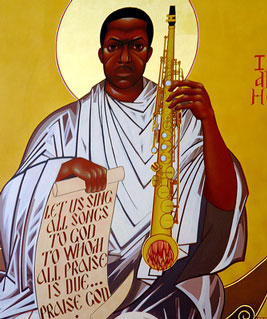
I might actually be more sympathetic, at least in theory, to the impulse (hee hee, pun intended) behind Saint John Coltrane Church.

But maybe I just dig the icons.